

A hillbilly engineer, a plumbing crisis on a Columbus food truck, and the patented wrench that took five prototypes, four factories, and one pandemic to deliver.
By Greg Rollett, Grommet
This article is presented by Grommet, the leading product discovery platform for new and emerging makers.
Michael Newman was wedged under a stainless-steel sink, six foot five and two hundred and forty pounds of Appalachian-born mechanical engineer folded into a space never designed for a body his size. The food truck belonged to his wife, a classically trained chef whose turducken taco had been named Ohio’s best in Food Network magazine. The Coop served elevated Americana on the streets of Columbus, Ohio, and Michael was its on-call mechanic. Something upstream of the sink was leaking, and the adjustable wrench in his pocket was the wrong tool for a space that barely had room for his elbow.
He fought the plumbing, gave up, and slid back out. By morning, the kinematics for what would become the patented OMNILOCK wrench were fully formed in his head.
The aha moment arrived whole from my subconscious. It was nice to find my creative side had supplied the concept without any real effort. Now I just had to pursue it.
Michael Newman
That pursuit, launched on Grommet as the Toler UNION on October 23, 2025, would consume seven years, five tool iterations, four factories, a pandemic, and a tariff scare that nearly sank the project the day after his first backers received their orders.
From Appalachian Hills to the Columbus Idea Foundry
Newman’s biography reads like a set of contradictions that somehow stack up. He grew up a self-described hillbilly in the hills of Appalachian Kentucky. He got his first taste of tinkering hot-rodding electric guitar circuits in his teens, became a semi-professional musician who recorded tracks that charted on college radio with his brother Adam Newman, and worked as a cable guy to pay the bills. Somewhere between the gigs and the service calls, he earned a mechanical engineering degree.
During that program he helped manage The Columbus Idea Foundry, at one point the largest makerspace on the planet. He watched his own name appear on patents and saw products he had designed land on big-box hardware store shelves. Then his wife opened The Coop, and he appointed himself its chief plumber, chief electrician, and chief problem-solver.
It is a résumé built for exactly one kind of invention: the kind that starts under a kitchen sink and ends with a tool that has to satisfy a guitar player’s ear for precision and an Appalachian kid’s respect for things that do not break.
One Wrench, Five Iterations, Four Factories
The first prototype of the OMNILOCK was a 3D print, built in a university manufacturing lab class. It showed Newman that the kinematics were viable, but the plastic could not take the forces a real user would put through it. He had to wait for a steel version before he could verify that the self-adjusting, ratcheting action he had sketched in his head actually worked in the hand.
It did. Newman iterated through five complete versions of the Toler UNION and walked away from four manufacturing partners before finding a factory capable of holding the tolerances his design demanded at a price the market would bear. The inner jaw alone went through rounds of finessing before it would lock and unlock smoothly under rotation while still holding a secure grip.
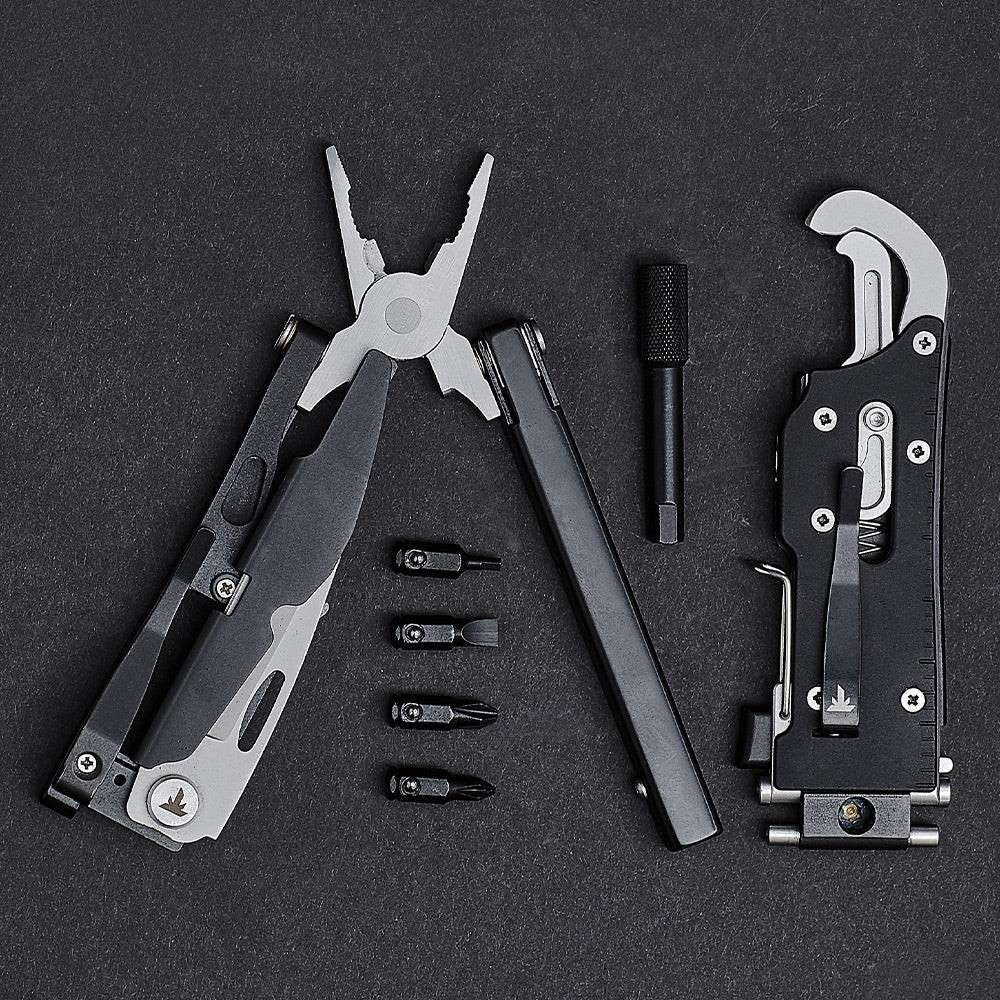
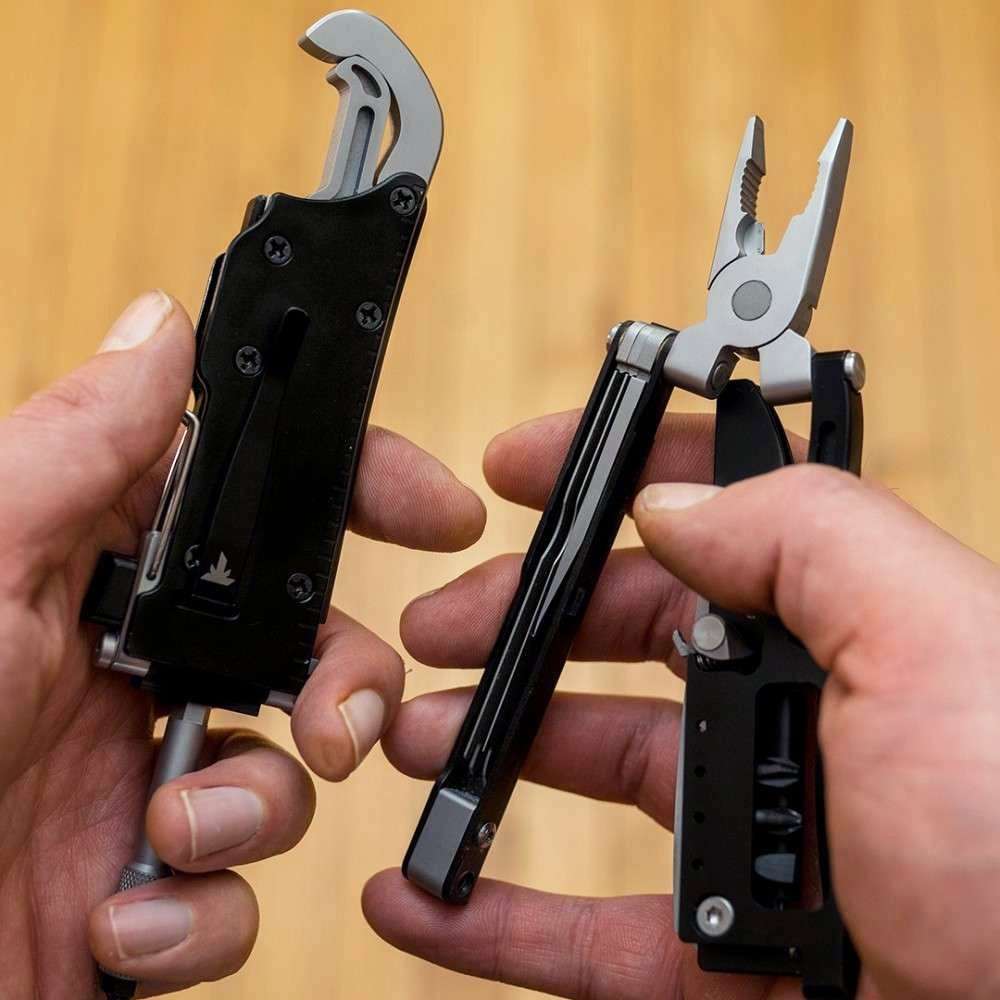
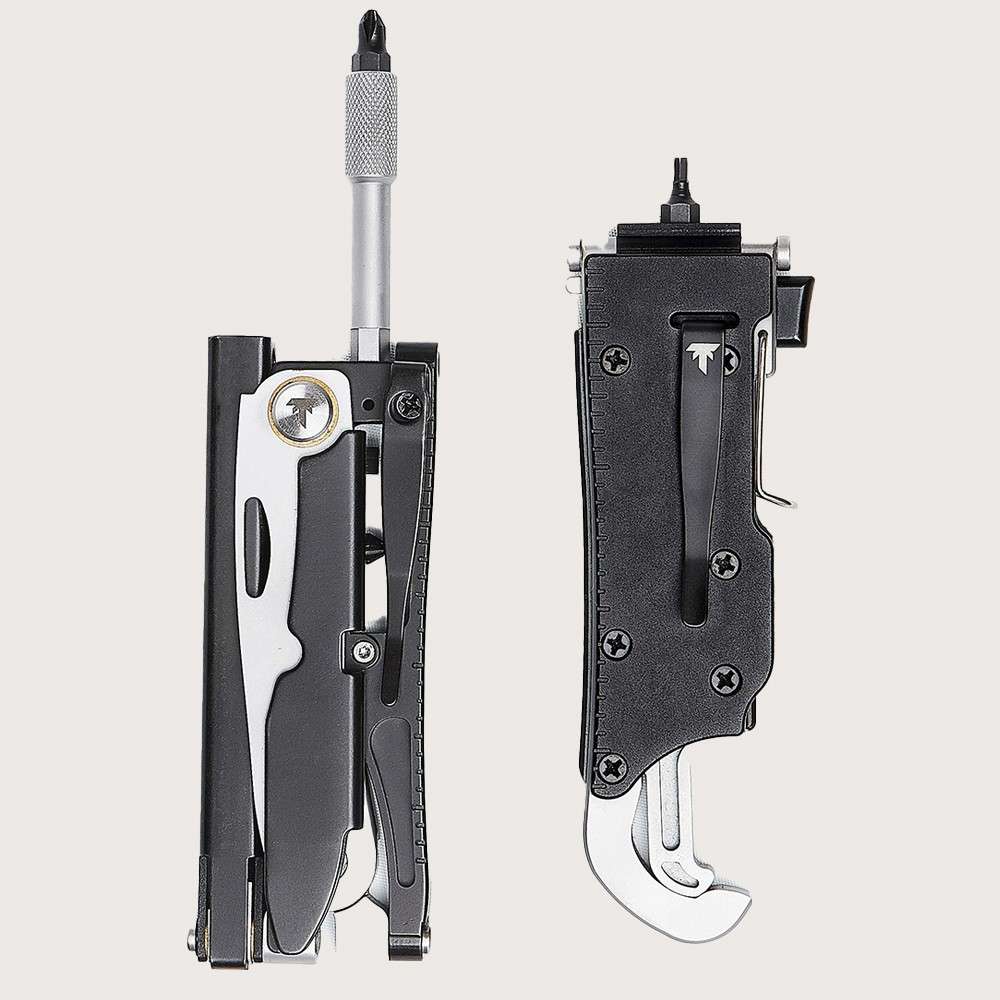
The finished tool is, in practice, two tools. The UNION splits along a central hinge into a wrench half and a pliers half, so a user can hold a joint steady with one hand and drive it home with the other. It carries a locking D2 tool-steel knife, a 440C stainless wood saw, a D2 metal saw, an awl, and a bit driver. The OMNILOCK adjusts automatically from a quarter inch to three-quarters of an inch, covering both metric and imperial fasteners without a single dial to turn. Newman’s listing on Grommet counts 470-plus task combinations.
A Month from the Factory Floor to a Supply Chain in Flames
Newman was in China finalizing production in December 2019, unaware of what was spreading through the country he was traveling in. By February 2020, he knew. He had backers waiting and capital committed, and no choice but to keep pushing his factory through a pandemic that was flattening supply chains across the world.
Then a supply agent vanished with a significant amount of money and tooling, badly damaging his relationship with the factory. Newman absorbed the loss personally to keep the project moving. The factory eventually came around once they understood he was a fellow victim.
I will never again doubt my ability to endure.
Michael Newman
On April 1, 2025, after more than ten thousand Indiegogo backers had waited through years of delays, the first UNION shipments were fulfilled. On April 2, the United States announced new tariffs on tools already on the water, a move that would have bankrupted the company the moment its cargo cleared port. A frantic scramble ended with a creative stay inside a bonded warehouse, and the official landing happened on the exact day the tariffs were first paused. “It was a nail biter,” Newman says, “to say the least.”
The Weekend at Blade Show
Seven years earlier, with a week-old prototype in hand, Newman had walked into the Blade Show in Atlanta and casually asked people if they wanted to see something cool. He spent the weekend in the company of the most respected multi-tool designers in the industry. One of them, the creator of what Newman still considers the most innovative multi-tool ever made, sought him out unprompted.
By weekend’s end, that designer had told Newman he considered him part of a rarefied group of peers, a set that now totaled three people, Blade Show legend included.
I felt like a Beatle had told me they loved my songwriting. Setting aside my marriage and the birth of my children, that was probably the best weekend of my life.
Michael Newman
A Seventeen-Year-Old and a Dorm Full of Repairs
Of the thousands of pieces of feedback Newman has received, one still gets to him. A seventeen-year-old high-school robotics competitor posted a YouTube review of the UNION, parsing the finer design points with a fluency Newman recognized immediately. The kid was headed to engineering school and wrote as if Newman had become a model for the engineer he wanted to be.
Years later, that same young man reached out again. The UNION had become the de facto repair kit for his entire college dorm. “It felt good to know I was maybe inspiring someone like who I used to be,” Newman says.
What the UNION Is a Down Payment On
Newman is careful about the future he is chasing, because it is, as he puts it, “ridiculously self-aggrandizing.” He believes the right technological advancements are the greatest engines of social change, and he wants the UNION to eventually fund his work on point-of-place manufacturing and individual robotic agriculture, where families harvest their own energy, grow their own food, and manufacture the goods they need on demand from digital designs shared freely.
In the near term, the UNION is a sandbox for modules. The central hinge accepts swap-in halves: a bushcraft setup for a day in the woods, an electrician module for a service call. The wrench half stays; the other evolves with the day ahead of you.
For now, the first UNION sits in glove boxes, emergency kits, bicycle saddlebags, Air Force hangars, and one Ohio food truck where the entire idea started. The multi-tool that was supposed to replace a drawer has, in Newman’s own words, replaced the moment of defeat that used to come with realizing you brought the wrong tool.
Get 20% Off Toler UNION
Right now, readers of the Grommet Blog can get 20% off Toler UNION through our maker community on Grommet. Just head over to the product page, give it an upvote, and your discount unlocks instantly.